Extract from
Published
by Sheffield City Libraries 1986
(Out of
print 2010)
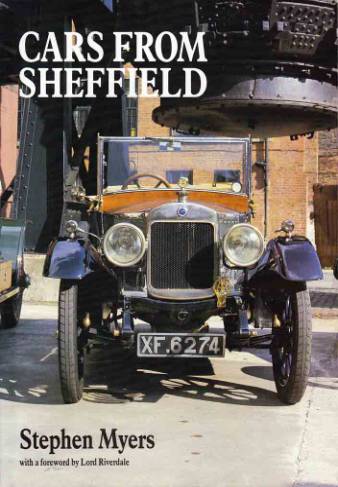
Cover
picture is a Charron Laycock
Manufactured by Stringer & Company (Sheffield)
Ltd., Wincobank Steel Works, Sheffield 9
John Charles Stringer was known as Mr.
Crankshaft by his colleagues in engineering; his Wincobank Steel Works
produced crankshafts and other forgings mainly for the motor industry. A family photograph clearly shows a
collection of products including crankshafts, steering arms and refrigerator
condensers[1]. In1907 a two-page article appeared
in The
Commercial Motor. The works and products were described and we are told
that 'steel of their specification' was used.
Mr Geoffrey
Goodison, the grandson of the founder, recalls his grandfather and grandmother
arriving at
Doncaster Races in a rather grand Rolls Royce. He reckoned that the Derby
company paid for a crankshaft supply with the
car when finances were tight. A nice story but impossible to prove.
Given the
links with the motor industry, engineering facilities, metallurgical knowledge
and apparent enthusiasm, the lure to produce
a complete Stringer car must have been great. Further encouragement would
probably have come from the many poorly built machines available at
the time. John Charles engaged G. Bullock[2],
a former L.G.O.C. draughtsman, to Design the
car, and the first model appeared in 1913. A striking two seat drophead body,
with steeply raked windscreen, clothed the mechanicals which were
all produced in the Wincobank factory. Stringer placed great emphasis on materials as
this introduction to the 1913 catalogue shows:
“We
have pleasure in introducing you to our `Winco' two-seater light car. This car
has been evolved after very strenuous tests
undertaken in the hilliest parts of Yorkshire and Derbyshire,
lasting over 16 months; and our aim has been to design a car which would
combine reliability, simplicity of control,
flexibility and hill climbing power, and we think we may state in all
confidence that we have achieved this.
The car meets a
great need of the present day owing to its economy, comfort and smart appearance.
The whole of the workmanship and material in the chassis are of the finest quality,
and all the parts which have to take great strains are made from special
Nickel Chrome Steel.
Special attention has been paid to the
springs which are extremely strong and very flexible being made from special
Chrome Steel.
We have specialized in steels for motor
car construction for the last 10 years, and have been able, in consequence, to
utilise our experience in this direction to ensure the use of the right
materials in the proper place.
The tyres are larger than is actually
necessary; this, of course, slightly increases the cost of the
car, but we are assured that the infinitely greater comfort in riding and the
longer life of the tyres is a great advantage to the user.
THE
CAR IS BUILT OF BRITISH MATERIALS THROUGHOUT".

1913 Winco two seat light car.
Print taken from
original glass plate negative, courtesy of John Stringer.
Front and rear axle were mounted on cantilevered semi
elliptic leaf springs. Cold drawn steel tubing was used for the front axle, with
high tensile steel stub axles. The rear axle was a composite construction formed
from gearbox and final drive, drive transmitted by torque tube. The three speed
with reverse gearbox and final drive gears were all made from the Company’s
own special material and case hardened.3 The chassis frame was of the
ladder type construction, the main side members being of deep section ash
enclosed between two spring steel flitch plates. The assembly was riveted
together, and was 'of exceptionally strong construction'.
The engine, also built by Stringer, was a twin cylinder
vertical unit, water-cooled. Bore of 33/8 inches and stroke 35/8 inches
gave a capacity of 64.86 cubic inches (1062.9 cc). It was rated at 9.2 hp (RAC).
The balanced crankshaft ran in phosphor bronze bearings, and an enclosed chain
drove the camshaft, valves being side mounted. The automatic carburettor and
chain
drive magneto endowed the car with a very respectable claimed 45 mpg. Final
details included worm and nut irreversible steering and leather lined cone
clutch.

1914 two cylinder engine of Stringer's own manufacture.
Photo courtesy John Stringer.
It was common for motor manufacturers to
demonstrate their products by entering competitions.
Stringer were no exception and on June 1914 they entered a specially prepared
single seater in a handicap race at Brooklands. The driving was entrusted to the
designer, George Bullock. He won the event but seemed to be favoured by
fortunate handicapping. Light Car and Cyclecar of June 3rd 1914 described the event:
“The story of
the race is soon told. Of the fifteen entrants fourteen
started, the makes represented being Singer (2), Hillman, Bugatti,
GWK, Swift, Morgan, Carden, Simplex, Wico, Buckingham,
Baby Peugeot and Tweenie. How it came about that the Winco was in receipt of
1m 38s start it is hard to say, for in order to have
overhauled it the scratch car, B. Haywood's Singer, would have had to
travel at an incredible and impossible speed. As it was there was only one car in the race — the Winco — which
finished the 5 3/4
miles course almost three quarters of a
mile ahead of the second machine at a speed of 60 66
mph. The Winco driver, G. Bullock, handled his mount excellently, and we fancy
that he was not unduly pressing it towards the end."
As
with most other
firms, the Stringer factory turned to munitions during the First World War and the car production was shelved. The next recorded model appeared in 1922.[4]
The
car had been simply known as the Winco with deference to the
Wincobank factory. The post war models were known initially as Stringer Winco
and, after 1923, Stringer Smith. Remaining family records do not give us the
identity or position of Smith, although it has been suggested he may have been
financier or designer.
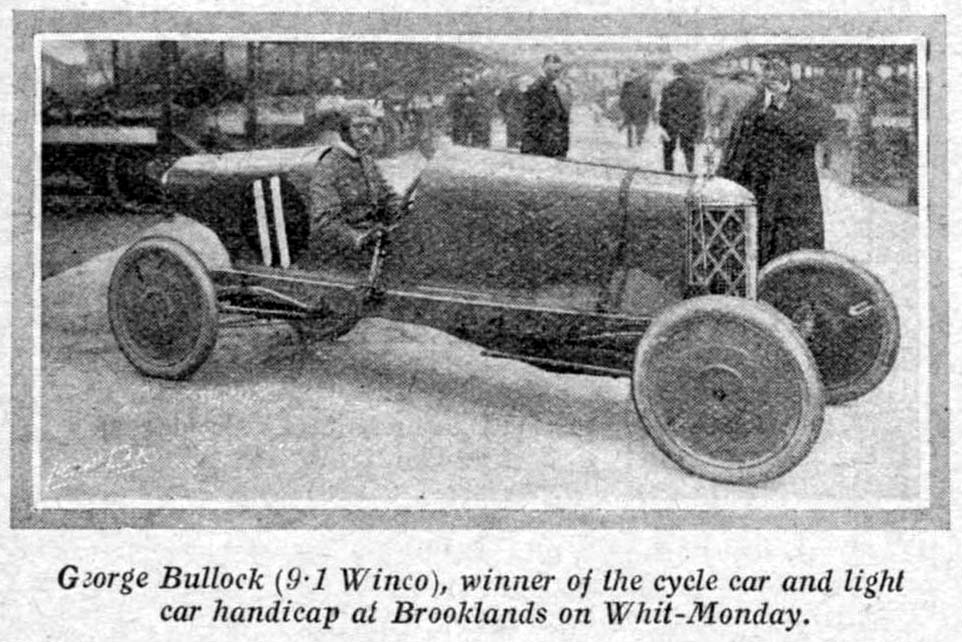
The single seat Stringer pictured at the June handicap
meeting at Brooklands. The car's designer George Bullock wheel.
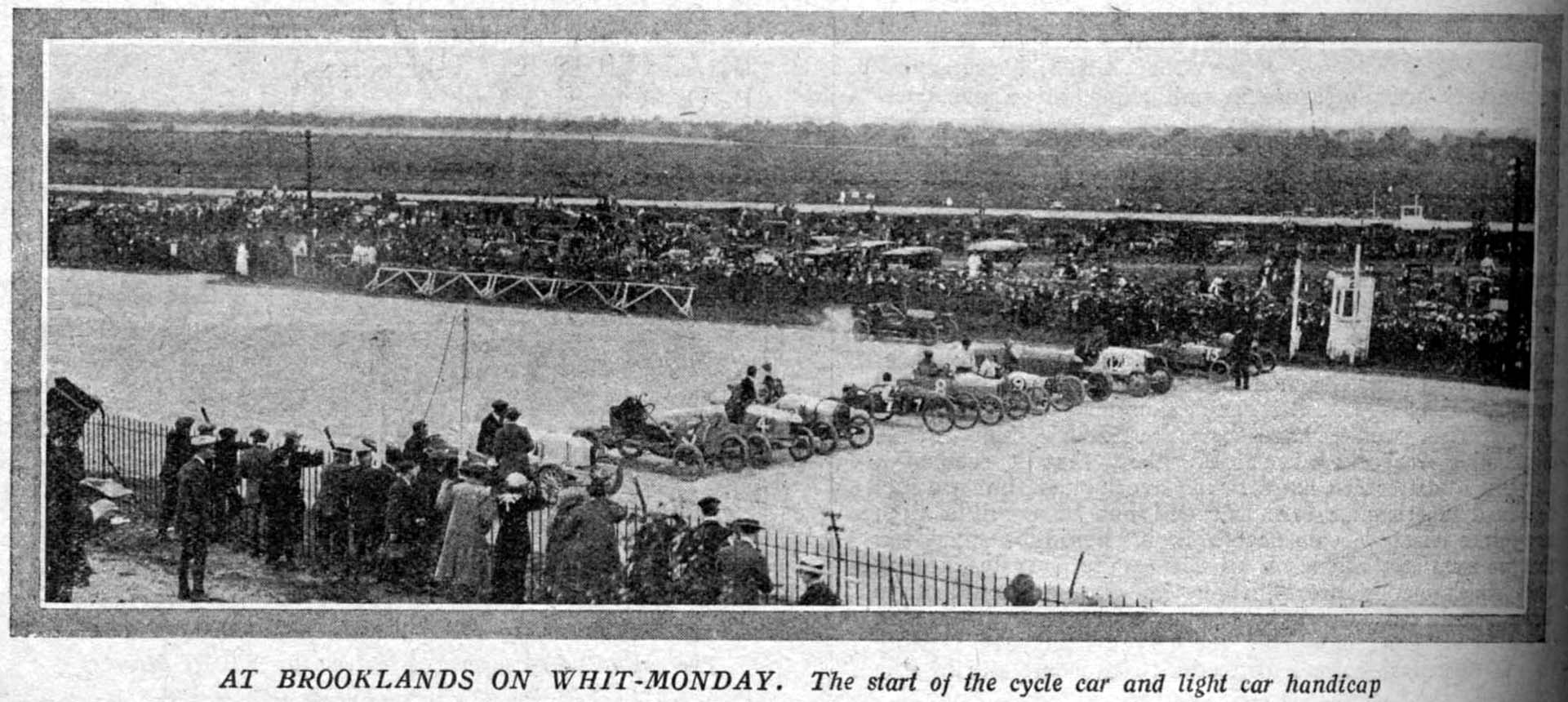
Start line-up for handicap race at Brooklands on June 3rd
1914. George Bullock on the Stringer is fourth
Details of the post-war car were released
nationally. The first appeared in Light Car and Cyclecar[5]
in their show report of 1923. However, we do know from an original registration
document that a car was on the road in June 1921. The new car bore a similarity
with the pre-war model, a two seater with raked windscreen but with much
smoother and rounded lines. Whereas before the dicky seat was an extra, it was
original equipment on the later model. The cost of producing their own engine in
those austere times must been too much, or they preferred a smoother four
cylinder. For whatever reason, proprietary engines were used in all the post-war
cars. The 1098cc Alpha was chosen, certainly a popular engine, and used to power such cars as
Adamson, Arden, Raleigh and Warren
Lambert. Side valves were used and stroke
were 23/8 inches and 31/4 inches respectively. The gearbox had been moved to the front
and was driven by a short shaft and two fabric discs. Gear ratios were:
Reverse
18.9 - 1
First 14.5 - 1
Second
7.35 - 1
Third
4.35 - 1
Final drive was by straight bevel, and
the rear axle was mounted, as before, on cantilever semielliptic springs. Torque
tube drive connected gearbox to rear axle. The overall length was 11’ 6"
and width was 4' 6 ". Wheels were Sankey double disc with 710mm x 90mm
tyres.[6] A post-war brochure
reveals that the front axle was now 'H' section, and states that, the 'Stringer
Mum medium light car is the ideal owner driver car for Lady or Gentleman.'

Two post-war Stringers; the upper car
stands outside the factory circa 1923. The numerous detail differences suggest a
lack of rationalisation.
Photos courtesy John Stringer

Further details of the car appeared the
following year, with an 11 hp model in
addition the previous 9 hp. Chassis details were the same, the engine having a
larger bore of 6mm, increasing the engine capacity to 1,330 cc. Actual power
output was 1bhp at 150rpm.
These models continued to be offered
until 1932; few alterations, if any, were made but electric start was fitted in
1928. Unfortunately no production records exist but John Charles Stringer's
grandson
remembers five complete cars in the factory in the early twenties. The price war
of the time was reflected in the falling prices for the Stringer Winco:
(Reference Light Car and Cyclecar)
Note the forty-five per cent price
reduction from 1923 to 1926.
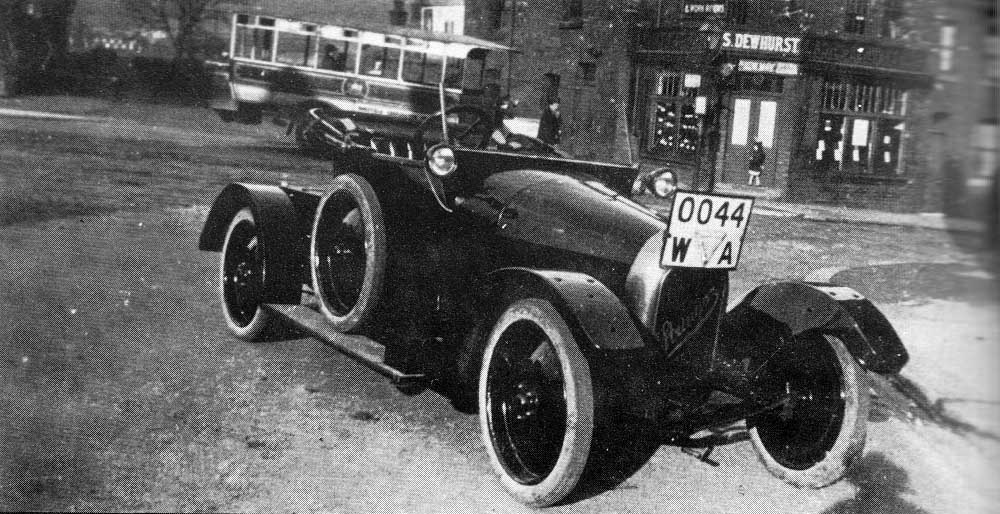
Another post-war car outside the factory. Sheffield
Corporation bus in the background. This part of Wincobank has changed little
since.
Photo courtesy John Stringer.
After car production ceased the factory continued with
engineering, and although the factory still stands it does not appear that any
of the cars have survived.
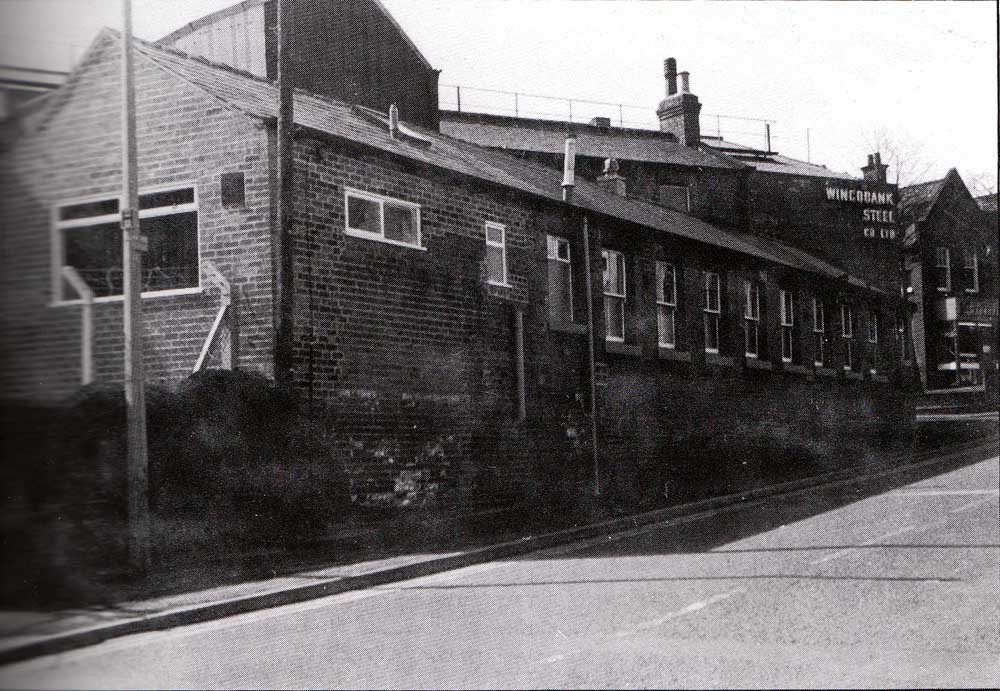
The stringer factory as it stands today.
Geoffrey
Goodison, the grandson of the Founder, recalled that
he borrowed a Stringer Winco from the factory around 1932 for a holiday in
Devon. On his return journey he adjusted the valve clearances to zero, in
ignorance, to try and eliminate excessive engine noise. He subsequently
knocked out a drive coupling. His grandfather saw to the repairs and instructed
the hapless
Mr. Goodison to learn to ride a motorcycle first — he took the advice.
Two original 'log' books are still in existence and show that
John Charles Stringer registered two Stringers in his own name. The first in
February 1921 was possibly a pre-war car since the engine is is dated as 1912
and the registration number is W 3827 (the prefix WA was used after September
1919). The second Stringer was a post-war car having the registration number WA
4696 and manufacture date of the engine is given as 1920. It was described as
follows:
Type
of body — 2 seater with dicky
Colour
— Royal Blue
Name
— Winco
Description
of Vehicle — W 25 11.9 hp
Engine
No. — 9792
Year
of engine — 1920
Rated
HP — 11.9 (4 @ 69 mm)
Date
of original registration — 30.6.21
This Stringer was licensed yearly, at a cost of £12, up to
1932 whilst in the hands of Mr. Stringer, but its fate after that time is
unknown. On a point of interest our Mr. Stringer is on record as having
registered a 'Deasy' car in 1920, number KS 161. It had apparently recently had
a gearbox overhaul at 'Whippets Ltd. Motor Works, Grantham' and the previous
owner had spent £200 'having everything put right'.
Stringer
Specifications
Model `Winco' light car
Wheelbase
— 9 ft 6 in
Track
— 4 ft 0 in
Bore
— 3 3/8 in
Stroke
— 3 5/8 in
Capacity
(2 cylinders) — 1062 cc
RAC H.P. Rating — 9.2
Year
introduction — 1914
Price
— Chassis — £134
— Two
Seater — £150
— As
above with hood and additional accessories — £165
Model 'Stringer Winco' ('Stringer Smith') 9 hp
Wheelbase
— 8 ft 10 in
Track
— 4 ft 0 in
Bore
— 60 mm
Stroke
— 95 mm
Capacity (4 cylinders) — 1088 cc
RAC H.P. Rating — 9.02
Year
introduction — 1923
Price
— Two Seater — £220
Model 'Stringer Winco' 11 hp
Wheelbase — 8 ft 10 in
Track — 4 ft 0 in
Bore
—
76 mm
Stroke
— 95 mm
Capacity
(4 cylinders) — 1330 cc
RAC H.P. Rating — 11
Year introduction — 1924
Price (initial) — Chassis — £240
— Tourer — £240*
*The Stringer was listed until
1929. For price variations see text.